
In 2026, with all the AI writing assistants available, you might think the humble thesaurus is outdated. But here’s the truth: understanding how to effectively use a thesaurus remains one of the fundamental skills that separates amateur writing from professional work. It’s not about replacing AI tools; it’s about developing the skill to choose the perfect word for every situation. Let me show you exactly how to use this powerful tool to elevate your writing from basic to compelling.
Check out this article: 25 Steps – How to Become a Better Writer Immediately
What You’ll Learn
- What a thesaurus actually does and why it matters
- The difference between synonyms and antonyms
- How to use thesaurus.com effectively
- When to use advanced vocabulary vs simple words
- Common mistakes to avoid when using a thesaurus
- Practical examples of improving your writing with synonyms
Understanding What a Thesaurus Does
Before I explain how you can use a thesaurus, let’s clarify what it actually is. A thesaurus helps us find synonyms and antonyms. Synonyms are words that are very similar to each other, while antonyms are words that are opposite of each other.
Here’s a practical example. If I look up the word “walk” in a thesaurus, I’ll see words like:
- Stroll
- Saunter
- Trudge
- Run
Now, each of these words has its own specific meaning. The word “run” is clearly different from “walk,” right? They convey different speeds and intensities. But all these words are related in that they mean moving forward using your feet. Whether you run, trudge, saunter, stroll, or walk, you’re always moving forward using your feet—that’s the connecting thread.
This is what makes them synonyms: they’re related concepts with nuanced differences that allow you to express precisely what you mean.
Why You Should Use Synonyms in Your Writing
You might wonder: why would you use “trudge” or “saunter” instead of just writing “walk”? The answer is simple: to make your writing more interesting and more advanced.
Let me show you what I mean with two examples that illustrate the difference between basic and elevated writing.
Example 1 (Basic writing): “Kimberly walked to school very slowly. She didn’t like school. She always got bullied. She always ate lunch by herself. She didn’t have any friends.”
Who do you think wrote this? If you had to guess—an elementary school student, a high school student, or a university-educated writer?
Most people would say an elementary school student, and they’d be right to think so. This passage has very short sentences and uses very simple words. There’s nothing technically wrong with it, but it reads at a basic level.
Example 2 (Elevated writing): “Kimberly trudged to school, wishing she could disappear into the dreamy morning mist. The incessant bullying had left her spirit hiding in a hollow of deafening isolation.”
Now who do you think wrote this? It’s clearly more sophisticated. The vocabulary is richer (“trudged” instead of “walked slowly,” “incessant” instead of “always,” “deafening isolation” instead of “she didn’t have any friends”). The sentence structure is more complex and creates a stronger emotional impact.
This is the power of using a thesaurus effectively. The same basic story—a lonely girl walking to school—can be told at vastly different levels of sophistication depending on word choice.

Why Improving Your Writing Matters
From my experience as a professional writer, I can tell you that improving your writing skills opens doors. When you can write at a higher level, you get more respect:
- From your teachers and professors
- From your employers and clients
- From your customers
- From your colleagues and peers
People take you more seriously when your writing demonstrates sophistication and precision. In 2026, even with AI writing tools everywhere, the ability to craft genuinely good prose remains a valuable and respected skill.
How to Use a Thesaurus to Improve Your Writing
While you could use a physical thesaurus book, you can also use the online thesaurus.com because it’s faster and more convenient. Let me walk you through how you use this tool in your daily writing.
Step 1: Enter Your Word
When I want to find alternatives for a word, I simply type it into the search box on thesaurus.com. Let’s use “walk” as our example.
Step 2: Understand the Tabs
This is crucial and something many beginners miss. When you search for a word, you’ll notice multiple tabs at the top of the results page. These represent different meanings or uses of the word.
For “walk,” you might see:
- Three noun definitions
- One verb definition
Most commonly, when you’re looking for action words, you should be interested in the verb form—”to move along on foot.” So click on that specific tab to narrow down your results.
Why this matters: If you’re trying to find synonyms for “walk” as a verb (the action of moving), but you accidentally click on one of the noun tabs, you might see words like “pathway,” “road,” “street,” or “track.” Those have nothing to do with the action of walking—they’re places where walking happens. You’ll get really confused if you try to use those words as verbs in your sentences.
This is why understanding parts of speech (nouns, verbs, adjectives, adverbs) really helps. If you know you’re looking for a verb, you can click directly on the verb tab and get only verb synonyms.
Step 3: Review Your Synonym Options
Once you’ve selected the correct tab, you’ll see all the available synonyms. As you scroll down, you’ll also see antonyms—words that mean the opposite. For “walk,” antonyms might include “stay” or “stop,” which clearly convey the opposite action.
Further down the page, you’ll find even more related words, and if you scroll all the way to the bottom, there are often additional pages of options.
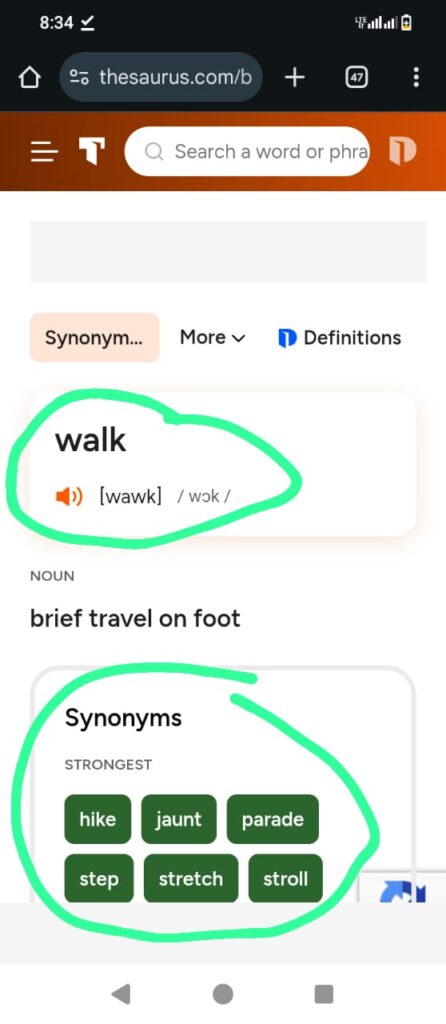
Step 4: Identify Commonly Used Words
Here’s something you need to learn: not all synonyms are equally useful. Some words listed in a thesaurus are quite obscure and rarely used in modern writing.
For example, when you look up “walk,” you’ll see words like “perambulate” and “wend one’s way.” You can rarely encountered them in professional contexts. They’re technically correct synonyms, but they’re not practical for most writing situations.
Fortunately, thesaurus.com has a helpful feature. You can click a box that highlights only the common words and filters out the more obscure options. This helps you focus on synonyms that your readers will actually understand and that won’t seem pretentious or overly academic.
Step 5: Choose the Right Synonym
This is where skill and judgment come in. Not every synonym works in every context. When I’m choosing which word to use, I consider:
Connotation: What feeling does this word convey? “Trudge” suggests difficulty and reluctance. “Stroll” suggests leisure and ease. “March” suggests purpose and determination. All describe walking, but with very different emotional tones.
Intensity: Some synonyms are stronger or weaker than others. “Sprint” is more intense than “jog,” which is more intense than “walk.”
Formality: Some words are more formal than others. In a business report, you might write “proceed” instead of “walk.” In a blog post, “walk” is perfectly fine.
Clarity: Always ask yourself: will my reader understand this word? There’s no point in using an advanced vocabulary word if it confuses rather than clarifies.
Common Mistakes Writers Make
Here’re some mistakes that writers commonly make when using a thesaurus which you should avoid:
1. Not understanding parts of speech As I mentioned earlier, clicking on the wrong tab (noun instead of verb, for example) leads to completely inappropriate word choices. Take time to understand whether you need a noun, verb, adjective, or adverb.
2. Using obscure words to sound smart most writers use words like “perambulate” when “walk” would be clearer and more effective. Using unnecessarily complex vocabulary doesn’t make you sound educated—it makes you sound like you’re trying too hard. Good writing is clear first, sophisticated second.
3. Ignoring connotation Just because two words are synonyms doesn’t mean they’re interchangeable. “Cheap” and “inexpensive” are synonyms, but “cheap” has a negative connotation while “inexpensive” is neutral. Always consider the feeling a word conveys, not just its dictionary definition.
4. Overusing advanced vocabulary When it’s your first time to use thesaurus, temptation to go overboard, replacing every simple word with a complex alternative. The result would always be overwrought, difficult-to-read prose. To curb this, use advanced vocabulary strategically, mixing it with simpler words to maintain readability while elevating the overall quality.
5. Not reading the full definition Sometimes you’ll see a synonym that looks perfect, but when you check its full definition, you’d realize it doesn’t quite fit your context. Always verify that a word means exactly what you think it means before using it.
The Practical Writing Process
Here’s how you can actually incorporate thesaurus into your writing workflow in 2026:
First Draft: Write quickly without worrying too much about word choice. Use whatever words come naturally, even if they’re simple or repetitive.
Second Draft: This is where you should bring in the thesaurus. Identify words that appear too frequently or seem too basic for the tone you’re aiming for. Look up alternatives and choose replacements that add precision and interest.
Final Review: Read through one more time to ensure your word choices sound natural and don’t disrupt the flow. Sometimes a thesaurus suggestion looks good in isolation but sounds awkward in context, so you can replace it with something simpler.
The key is balance. You don’t want your writing to sound like you swallowed a thesaurus, but you also don’t want it to sound elementary. The goal is sophisticated clarity.
Thesaurus in the Age of AI
You might wonder: in 2026, with ChatGPT, Claude, and other AI writing assistants available, do you still need to manually use a thesaurus?
My answer is yes, for several reasons:
Control: When you use a thesaurus, you’re making deliberate choices about every word. AI might rewrite entire sentences, changing more than you wanted to change.
Learning: Using a thesaurus teaches you new words and their nuances. Over time, this will expands your natural vocabulary so you don’t need to look things up as often.
Precision: You can select exactly the right synonym for your specific context. AI might choose a technically correct synonym that doesn’t quite fit the tone you’re going for.
Cost: Thesaurus.com is completely free. Some AI tools require subscriptions for full access.
That said, AI tools and thesaurus use aren’t mutually exclusive. Sometimes you should use both—you can use a thesaurus to find the perfect word, then ask an AI tool if it sounds natural in context.
Your Writing Challenge
Here’s what I recommend you do to improve your writing today: take a piece of writing you’ve already completed—maybe a blog post, an email, or an essay. Identify three words that appear multiple times or seem too basic. Look those words up in a thesaurus, find more sophisticated alternatives, and rewrite those sentences.
Pay attention to how this changes the feel of your writing. Does it sound more professional? More engaging? More precise?
This exercise will transform your writing over time.
Final Thoughts
For most writers, the Thesaurus remains one of their most-used writing tools, even in 2026 with all the advanced technology available. It’s not about showing off vocabulary—it’s about expressing ideas with precision and creating writing that commands respect and attention.
Whether you’re writing blog posts like I do, crafting business emails, completing academic assignments, or working on creative projects, the ability to choose the right word for the right moment is invaluable. The thesaurus gives you options. Your judgment and skill determine which option to choose.
Start incorporating thesaurus use into your writing process, and I guarantee you’ll see improvement in how people respond to your work.
Looking for more writing tools to enhance your work? Check out our reviews of grammar checkers and AI writing assistants to build your complete writing toolkit.
Want to share your own writing tips? Join Inkwrit and connect with fellow writers improving their craft.

Author: Bridget Austin
Ifeoma, who writes under the pen name Bridget Austin, is the founder of Inkwrit — a freelance writing platform built for African writers and storytellers. With a background in copywriting and content strategy, she created Inkwrit to give African voices a professional home to publish, build portfolios, and grow their writing careers. When she's not building the Inkwrit community, she writes about freelance writing, African literature, and the business of creative work.