Writer’s block is the condition of being unable to write despite having the time, intention and desire to do so — and it is more common, more treatable, and less permanent than most writers fear. Writer’s block is the single most frustrating experience a writer can face — and if you have ever sat at your keyboard at nine in the morning and still had nothing on the page by four in the afternoon, you already know exactly what that feels like. You have a story, a message, something you genuinely care about, and yet not a single word will come. Or worse, the words come and you immediately know they are rubbish, so you delete them, and the blank page stares back at you exactly as it did before.
The good news is that you are not alone, and you are not broken. Some of the most productive writers in the world — authors with nearly two hundred published books, novelists whose work hangs in literary history — have sat in that same chair and felt that same paralysis. What separates the writers who push through from the ones who stay stuck is not talent. It is understanding what writer’s block actually is, where it comes from, and what to do about it when it arrives.
What Is Writer’s Block?
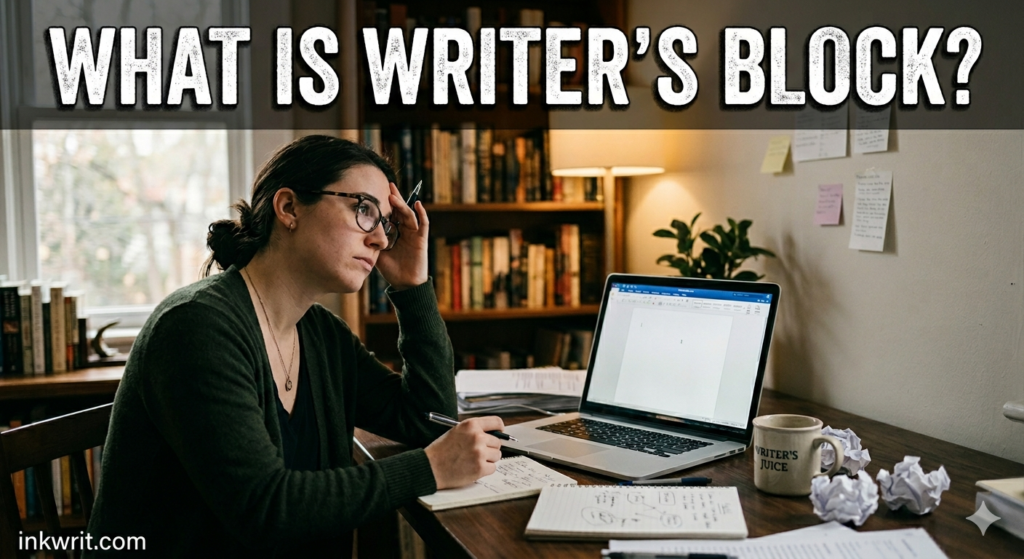
Writer’s block is the condition of being unable to produce new written work even when you have the time, the intention, and the desire to do so. It is not laziness, and it is not a sign that you have run out of things to say. It is, as author and writing coach Jerry Jenkins puts it, largely a myth — but a myth with real and identifiable causes underneath it. The feeling is real. The permanent creative paralysis it threatens is not.
It is also worth separating writer’s block from ordinary procrastination, because the two can look identical from the outside. Screenwriting teacher and author Jojo Moyes describes the procrastination experience with painful accuracy: you sit down to write and suddenly notice that your office is a bit untidy, some pencils could do with sharpening, you have probably run out of a vital supply and ought to pop into town — and by the time you get back it is half past three in the afternoon and there is really no point starting now. Tomorrow. Definitely tomorrow.
That is procrastination. Writer’s block goes deeper. It is when you genuinely try to write and the mechanism simply refuses to engage.
What Causes Writer’s Block?
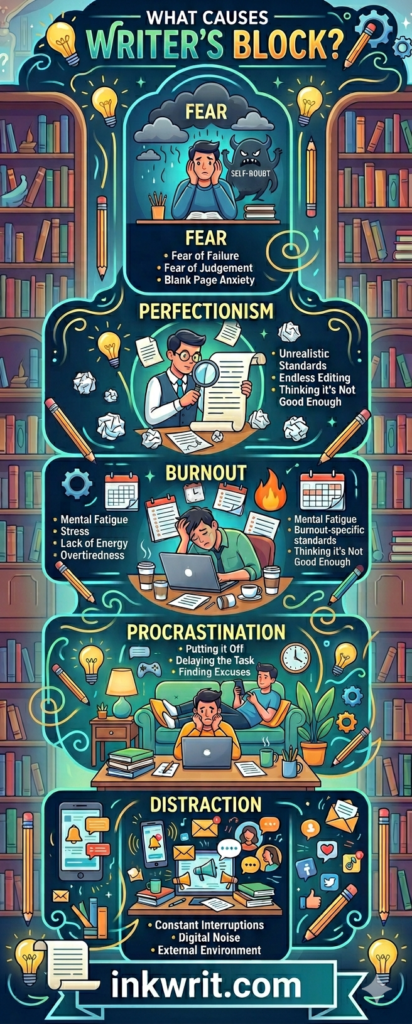
Understanding the cause of your particular block is usually the first step toward clearing it, because the causes are different and so are the solutions.
Fear is the most common root. As Jenkins explains, writers carry fear of not being good enough, fear of the competition, fear of rejection, fear that their dreams are too large for their abilities. Every time a writer begins something new, those fears arrive with them. This is not weakness — even writers with hundreds of books behind them feel it. The blank page carries genuine stakes, and your anxiety about those stakes is a reasonable response to a real situation.
Perfectionism is fear’s close cousin. It is the impulse to fix every sentence the moment it lands on the page, to tinker and revise while you are still supposed to be drafting, to spend hours on a single paragraph because none of it feels right yet. This is one of the most productivity-destroying patterns a writer can fall into, because a first draft that does not exist cannot be revised into something great. A terrible first draft can. As Jenkins describes it, perfectionism has its place — but that place is in revision, not in the initial act of getting words down.
Procrastination is something every writer does and most writers feel guilty about. Jenkins’s approach to this is worth taking seriously: he stopped fighting procrastination and started scheduling it. He builds non-writing days deliberately into his calendar, keeps his deadline sacred, and accepts that his subconscious is often doing useful work during the periods when he is not actively at the keyboard. The guilt, he argues, is the problem — not the time away from writing.
Burnout is the cause that tends to go unacknowledged the longest. Jojo Moyes describes suffering a severe bout of writer’s block that lasted over a month — sitting at her computer daily, writing nothing, or writing paragraphs she immediately recognised as rubbish. When she finally traced the cause, it was exhaustion. She had moved from book to book without gaps, without rest, without allowing her creative batteries to recharge. The well had simply run dry.
Distraction is increasingly a modern cause all of its own. Social media, email, a phone within reach — these do not just interrupt writing sessions, they prevent the depth of concentration that good writing requires. Jenkins is direct about this: there are no shortcuts. The question is how badly you want to succeed, because writing requires focused, undistracted effort, and that environment has to be deliberately created.
How Long Does Writer’s Block Last?
It depends almost entirely on what is causing it and whether you address it. For some writers it is a bad afternoon. For others, as Moyes experienced, it stretches into weeks or months. The writers who move through it fastest are usually the ones who treat it actively — who diagnose what is actually going on and respond to that specific cause — rather than waiting passively for inspiration to return on its own schedule.
Moyes describes two or three weeks of sitting at her computer and producing nothing before she finally changed her approach entirely. Once she did, the block began to lift. The turning point was not willpower. It was a change in strategy.
How to Overcome Writer’s Block
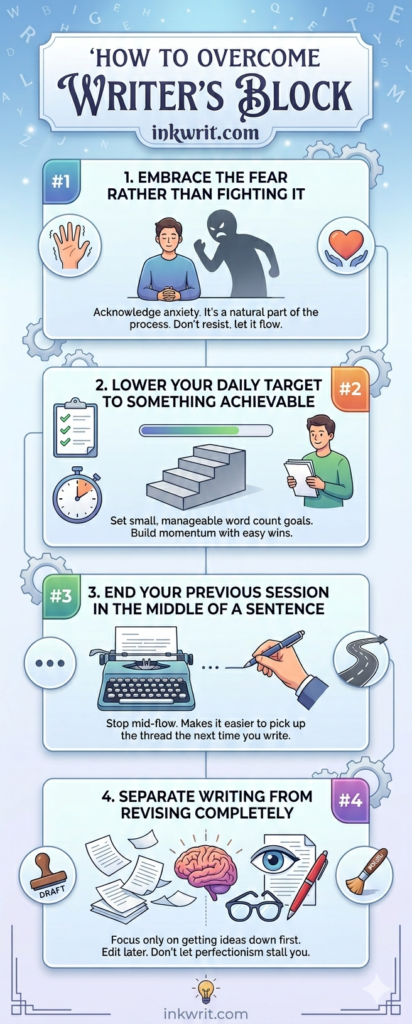
There is no single solution that works for every writer in every situation. But across the experience of writers who have worked through it, certain approaches come up again and again.
Research supports this. A study of 2,500 writers by researcher Sarah J. Ahmed at the University of North Florida aimed to identify the techniques that writers themselves use to overcome writer’s block. The research discovered a range of solutions, from altering the time of day to write and setting deadlines to lowering expectations and using mindfulness practices. These findings align closely with what experienced writers like Jerry Jenkins and Jojo Moyes describe from their own practice
Embrace the fear rather than fighting it. Jenkins’s counterintuitive approach is worth sitting with: instead of trying to talk yourself out of your fear, acknowledge that it is legitimate. You are not good enough yet — none of us are. The competition is vast and talented. Letting that humility land, rather than defending against it, can transform fear from something paralysing into something that motivates harder work. Dean Koontz, one of the most commercially successful novelists alive, describes the best writing as being born in those moments when writers become acutely aware of the limitations of their skills. The fear is the fuel if you let it be.
Lower your daily target to something achievable. Moyes writes a thousand words a day. She is clear that she may delete 999 of them the following day — but the point is not that those words are good. The point is that her brain is moving forward, staying inside the world of the story, thinking subconsciously about the characters and plot even when she is not at her desk. If a thousand words feels too large, make it five hundred. Make it one paragraph. Make it one sentence. The marathon runner’s approach applies here: don’t look at the summit. Look at your feet. Take one step.
End your previous session in the middle of a sentence. This is one of the most practical pieces of advice Moyes offers, and it works precisely because it removes the starting problem. If you deliberately leave a sentence unfinished at the end of your writing day, you come back the next morning to something already in motion. You finish the sentence and keep going. You have bypassed the most terrifying moment — the beginning — entirely.
Separate writing from revising completely. If perfectionism is your block, the discipline of keeping these two activities separate is essential. During the drafting stage, the inner critic has no seat at the table. Your goal is production, not polish. Words on a page, even wrong words, even clumsy words, give you something to work with. A blank page gives you nothing. The revision stage is when the perfectionist instinct serves you — channel it there, and protect the drafting stage from it entirely. Learning to become a better writer is a long-term practice, and learning to write badly on purpose in a first draft is one of the most important skills in that practice.
Recharge your creative batteries properly. When Moyes’s block stretched beyond two weeks of nothing, she stopped trying to force the writing and started feeding her creative mind instead. She went to art galleries, museums, the cinema, the theatre. She started piano lessons and a course in music production. She worked through a book on drawing. The idea was not to distract herself but to ignite the creative spark through other forms of creativity and other people’s art. If you are stuck, consuming great work — reading widely, experiencing other creative disciplines — can stir something loose in ways that staring harder at a blank page cannot. This connects directly to what creative writing actually is at its core: an act of imagination that needs to be fed, not just exercised.
Schedule procrastination rather than fighting it. Jenkins’s method is practical and honest: accept that procrastination is part of your process, build it into your calendar deliberately, and keep your daily page count realistic enough that a few lost days do not destroy your deadline. The sacred thing is not the daily routine — it is the final deadline and the quality of the work. Everything else can be managed around those two fixed points.
Eliminate distractions with the same seriousness you bring to the work itself. Jenkins recommends establishing two non-negotiable rules: a strict writing schedule that everyone in your life knows about and respects, and a complete media fast during writing hours — no email, no social media, no radio, no television. When writing gets difficult, which it always does, the temptation to check something, anything, is overwhelming. Tools like the Freedom app can block social media access for a set period. Use them. Good writing software can also help here — distraction-free writing environments remove visual noise and keep you in the document rather than the browser. If you write on your phone, book writing apps for Android or the best writing apps for iPad often include focused modes built specifically for this problem.
Try writing something completely different. When Moyes returned from her creative recharge period, she did not try to force herself back to the same kind of writing that had dried up. Instead she tried a new form — narrative verse — and that decision produced Cloudbusting, one of her most distinct books. Sometimes the block is not about writing itself but about a particular approach to writing that has stopped working. Giving yourself permission to experiment with a different form, a different voice, or a different genre entirely can unlock something that pushing harder in the original direction never would.
Free Writing Software That Helps With Writer’s Block
The right tools will not write for you, but they can remove enough friction that starting feels less daunting. A distraction-free environment eliminates the visual clutter that makes a blank page feel even more exposed. Free novel writing software gives you a dedicated space that signals to your brain that writing is what is happening now — not browsing, not multitasking. Tools like FocusWriter or Manuskript keep the document front and centre with nothing else competing for your attention.
Writers who are anxious about producing clean prose in a first draft sometimes find that having a reliable grammar checker running reduces that particular anxiety — you know the technical errors will be caught, so the pressure to get every sentence right on the first pass lifts slightly. Similarly, using a thesaurus well can reinvigorate the experience of choosing words when writing starts to feel flat and mechanical.
If you write on a Chromebook, tablet, or phone rather than a desktop, there are strong free writing tools for Chromebook and dedicated mobile apps that give you the same focused environment on whatever device you actually have in front of you.
Writing Prompts to Beat Writer’s Block
When the specific project has stalled, sometimes the most useful thing is to write something else entirely — something low-stakes, something playful, something that gets the mechanism moving again without the pressure of producing publishable work. That is precisely what writing prompts are for.
The goal is not to produce a finished piece from a prompt. It is to remind your hands and your brain that writing is something you can do. Ten minutes on a prompt that goes nowhere is still ten minutes of writing, and it warms up the creative muscles in ways that staring at a stuck chapter cannot. Romance writing prompts work particularly well for fiction writers who are stuck on character or emotional dynamics, because they force engagement with feeling and relationship rather than plot mechanics. Even writers who are not working on romance find that the exercise of putting two characters in a scene and making them want something from each other tends to unlock voice.
For writers who are stuck at the very beginning and cannot figure out how to open their piece at all, revisiting the practical question of how to start writing a book can reframe what feels like a creative problem into a structural one — which has much more concrete solutions.
The Deeper Truth About Writer’s Block
Every canvas that hangs in a gallery started as a rough sketch. Every artist who painted those works sank their head in their hands at some point and thought: this is a disaster. Pain, disappointment, and fear are not obstacles to writing. They are part of the process. The moment you stop treating them as things that should not be happening and start treating them as ordinary features of creative work, they lose most of their power over you.
Writer’s block ends. It always has. What Moyes, Jenkins, and every working writer who has come out the other side will tell you is the same thing: the solution is almost never to wait. It is to understand what you are actually dealing with, to respond to it specifically, and to keep your relationship with the work alive even when the work itself is not flowing. Whether that means going to an art gallery, scheduling your procrastination, ending today’s session mid-sentence, or simply sitting down and writing the worst possible version of the thing just to have something on the page — movement beats stillness every time.
If you want to keep building the habits that make consistent writing possible, the 30-day book writing challenge on Inkwrit is a practical structure to write inside, and the writing advice collected here for aspiring writers covers the longer game of developing your craft beyond any single block. Writing is a practice, not a performance — and the practice continues even on the hard days.

Author: Bridget Austin
Ifeoma, who writes under the pen name Bridget Austin, is the founder of Inkwrit — a freelance writing platform built for African writers and storytellers. With a background in copywriting and content strategy, she created Inkwrit to give African voices a professional home to publish, build portfolios, and grow their writing careers. When she's not building the Inkwrit community, she writes about freelance writing, African literature, and the business of creative work.