
I’m not a US citizen and I’ve already finished college, but when Google Trends showed me how many students search for “Common App” every year—especially from August to December—I knew I had to research this topic. The numbers were staggering, and I realized this was information that genuinely helps people navigate a critical moment in their lives. If you’re a college student seeking to apply through the Common App route to get your degree, this comprehensive guide is for you. I spent hours researching tutorials from college admissions experts, learning every detail about the application process. Here’s everything I discovered to help you navigate Common App successfully in 2026.
What You’ll Learn
- What Common App is and how it works
- Step-by-step account setup process
- Understanding different application deadlines
- How to fill out each section properly
- Finding hidden supplemental essays
- Organizing your entire application project
- Common mistakes students make and how to avoid them
- Expert strategies for activities, academics, and essays

Understanding What Common App Actually Is
According to the College Essay Advisors tutorial I studied, Common App (commonapp.org) is the most widely accepted college application, used by over 1,000 colleges out of America’s more than 3,000 colleges. What makes it powerful is that the information you enter once gets sent to every school on your list.
However, one expert I researched, Eric from Solution Prep, emphasized a crucial point: the biggest mistake families make about Common App is assuming that if their colleges are on the Common App, they only have to complete the Common App portion and they’re done with all those schools. But as I learned through my research, that’s just not the case. Most schools require additional supplemental essays and questions beyond the main Common App.
Thomas Caleel, a former director of MBA admissions and financial aid for the Wharton School at the University of Pennsylvania, described August 1st as the day the new Common App opens—a day that “strikes fear into the hearts of millions of students and parents around the world.” But his perspective was encouraging: we don’t need to go into this with fear or trepidation. With proper preparation and understanding, you can navigate this process successfully.
Setting Up Your Common App Account
Creating Your Account
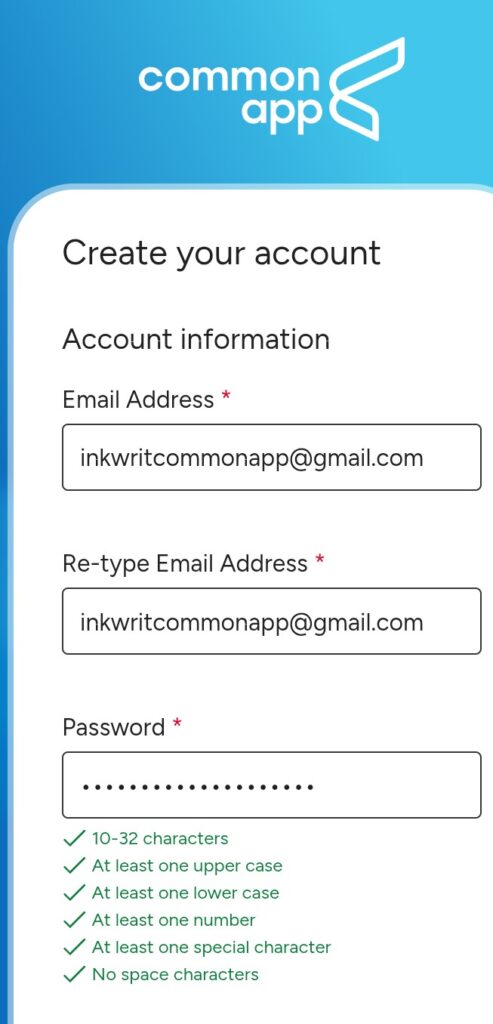
When I researched how to get started, the College Essay Advisors tutorial explained that you begin by going to commonapp.org. If you haven’t created an account yet, you’ll click “First Year Student” and fill out basic information before hitting “Create Account.”
If you already created an application before the Common App launched for the new application season, you can simply go to the login page and log in.
Choosing the Right Email Address
Thomas Khalil offered important advice about email selection that I found particularly valuable. He personally recommends using a personal email address rather than your school address. His reasoning makes sense: if you end up on a summer waitlist and you have your high school email address, you don’t know when that’s going to be cut off.
His suggestion is to set up your own Gmail address specifically for college applications—something like “[email protected]”—so you have everything in one place and you’re not losing important communications. He emphasized: please don’t use a silly email address that you developed a couple of years ago like “[email protected].” Set up a professional email address so you can monitor it properly.
If you want to give your parents access to that email as well, that’s fine, because then everybody has eyes on what matters. Every single communication with colleges will use that email address.
The Critical Importance of Attention to Detail
One aspect that struck me during my research was how much Thomas emphasized attention to detail during the setup process. He stated very clearly: “Be very, very, very careful here. It takes time. Capitalization, punctuation matters.”
He explained that while he doesn’t sound like someone sitting with a red pen eager to mark you down, attention to detail is crucial. Why? Because university life and academics involve a lot of detail—writing papers, taking tests. What universities want to know is: does this matter to you? If this application process matters to you and you’re not doing it the day before it’s due, you will go through it carefully and catch these errors.
His recommendation is to have parents or friends help with this section. It helps to have a fresh pair of eyes on your application to catch things like missed capitalization or periods.
Using the Preview Button
Another valuable tip from Thomas’s research: as you complete each section, press the preview button. This generates a PDF view on your screen of what the university sees when they look at your application.
This is really important because sometimes when you put information into Common App, it looks perfectly well-formatted. But when it translates to the screen view that admissions officers see, there might be glitches in spacing between words or paragraphs. So go through, check everything, and don’t do this last minute.
Understanding Your Common App Dashboard
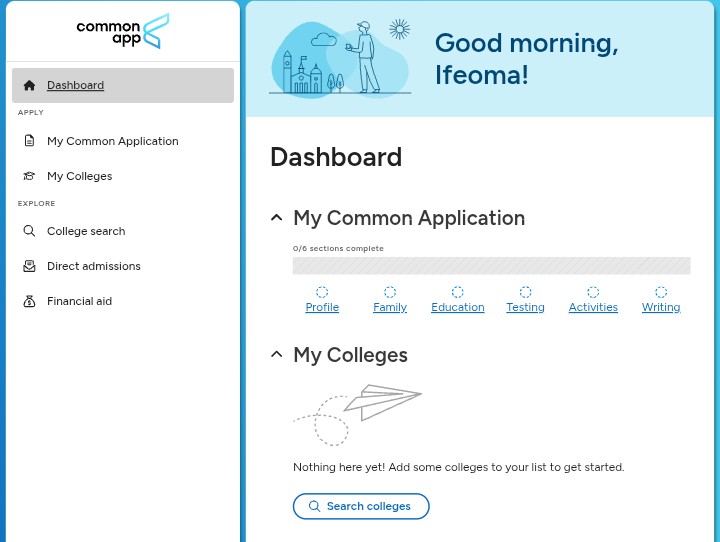
According to the College Essay Advisors tutorial, when you log into your Common App dashboard, you’ll find several key areas:
The Dashboard: This is where you’ll find your school list once you’ve added schools, and you’ll be able to keep track of deadlines.
Help Sidebar: On the right, there’s a help function that will be super helpful if you have any questions. You can search for answers, and odds are if you have a question, someone else has had a similar question in the past. You’ll be able to find the information you need here.
Main Tabs: The Common App tab collects information that will go to every school on your list. The sections include Profile, Family, Education, Testing, Activities, and Writing.
Navigating the Profile and Family Sections
Thomas emphasized that these sections require careful data entry. Make sure your address is correct, and ensure numbers, spacing, and all details are accurate. You’ll need to talk to your parents about information like:
- When did they graduate from college?
- When did they graduate from graduate school (if applicable)?
- What school did they graduate from?
- What was their major?
These things are important, take time, and you really have to ensure they’re correct.
The Academic Section: Tedious but Critical
Entering Your Courses
According to Thomas’s research, the academic section is “laborious, tedious, and backbreaking.” You have to enter every course you’ve taken—how it’s graded (quarterly or semester) and the grade itself.
Important guidelines he emphasized:
- Do not convert your scores to a GPA. Colleges will give very specific instructions.
- You have many grading system options: 0-100 scale, 4.0 scale, letter grades, IB, A-levels
- Pick the grading system that is correct for you and your school
- Use your transcript as your reference
He stressed that this is critical because if there’s a discrepancy when you’re admitted and they’re checking everything against your transcript, that could be grounds to question or even revoke your admission. Be very careful, thoughtful, and take your time.
The academic section in Common App is different from some schools that require you to enter all your coursework in their specific application sections. Both are time-consuming.
When You’ve Changed Schools
If you changed schools, you’ll get a prompt—usually a dialogue box asking “Please tell us why you changed schools.” Be thoughtful here. It’s usually around 200 words, and you don’t need to use all 200 words.
You can simply say “My family moved.” But if it’s more complex—like you were in a private school, didn’t like it, didn’t adjust well, felt the teaching wasn’t what you needed, and wanted a larger or different experience—you can explain that you shifted to public school (or vice versa). You have a chance to tell your story.
A Note for Parents
Thomas offered interesting advice for parents: he always advocates for students to do everything on their own. However, if parents really feel they need to get involved and want to help, one area where they can assist is entering courses into Common App. It’s long work, hard work, and takes a burden off the student. But in general, he emphasized: students should do this themselves. This is your future, your life. Make it count.
The Activities Section: Strategy is Everything
Understanding the 10 Activity Slots
According to the College Essay Advisors tutorial, in the Activities section you can list up to 10 activities you’ve been involved in. They typically recommend starting with the activity you’ve been involved with for the most amount of time, then going down from there.
However, Thomas provided more strategic guidance. Activities are very important, and you generally have 10 spaces. He emphasized: “You want to be thoughtful about how you organize that. Ideally this is organized in rank order—most important to least important to you.”
Activities Should Tie to Your Broader Strategy
Thomas repeatedly emphasized strategy throughout his tutorial. He explained: “When an admissions officer reads your application, this is not a linear march through your application. They’re referencing different points at different times. They’re looking at the activity list, reading your essays, bouncing back to the activity list, checking awards, looking at recommendations.”
Everything happens in a very short amount of time with constant cross-referencing. You want to make sure your activities line up with your essays.
What If You Have More or Fewer Than 10 Activities?
Thomas addressed common concerns:
If you have more than 10 activities: You’re going to have to use judgment. Don’t throw in activities just to fill the list.
If you have fewer than 10 activities: If you’ve done them deeply and well, that’s okay. You don’t need to add activities just to fill up the list.
Middle school activities: Really don’t want to include anything from middle school or earlier than high school. Exception: if there’s continuity since middle school—you’ve been playing a sport or doing an activity for 10 years—then by all means indicate that.
How to Describe Your Activities
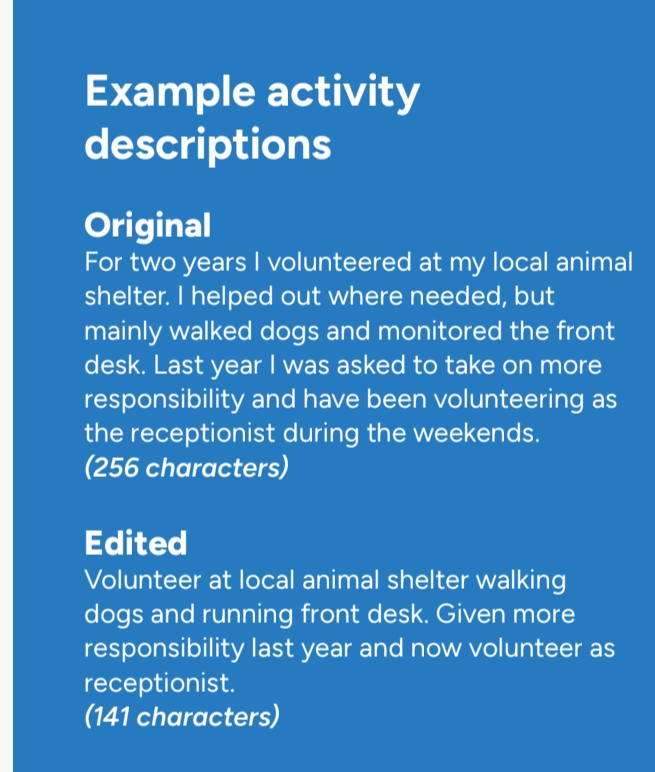
The system will ask for your position, the organization name, what it does, and then you have about 150 characters to describe it.
Thomas’s advice: “In the description, I want you being economical with your language. Don’t start with ‘I was the captain of the soccer team.’ They know that from the information above. Talk about leadership. Talk about awards. Talk about tournaments. Talk about things you did and abbreviate as much as you can.”
If it’s a very important activity, odds are you’ll also be addressing it in one or more of your essays, so keep that in mind.
Hours Per Week and Weeks Per Year Matter
Thomas emphasized: “Remember, hours per week and weeks per year. This is really important. If you do something for two hours one week or two weeks a year, that should not be a primary activity for you.”
Universities are now looking at whether you really love something—you’re probably doing it during the summer and also during the school year. These overarching continuous activities are becoming more and more important because they show genuine passion and curiosity.
Work and Family Responsibilities Count
Thomas made an important point: if you have to work or take care of family members, these are equally strong, equally valid activities. There’s a section in Common App where you can mark that you have these responsibilities and how many hours you spend on them.
He explained that many students felt they had responsibilities that don’t fit neatly into an activity category, and they worried about being penalized. Common App specifically gives you space and permission to include these responsibilities.
About the Resume Upload
Eric from Solution Prep noted that some schools give you a place to upload a resume, usually in the activities section. If a college has this option and says “If you have a resume you’d like to upload, put it here,” you should definitely do so.
Thomas provided guidelines for resumes:
- Should always be in PDF form
- Should under no circumstances be more than two pages
- Exception: extensive list of published research papers or highly competitive athletic achievements with tournaments and awards
- Be smart, be concise, focus on actions taken and results achieved
- Don’t just list things for the sake of listing them
The Awards Section
Thomas addressed common concerns about awards: “Many students will start to panic if they don’t have awards. Every student is different and it’s really important to keep this in mind. There will be students that have multiple awards and there will be students who have no awards, and both of them can be equally successful at top programs.”
The question is how are you positioning yourself and how are you evidencing your interest in things? The strategy comes from thinking ahead: What do I want to study? How have I evidenced my interest in this particular subject?
Understanding Application Deadlines
The Three Types of Deadlines
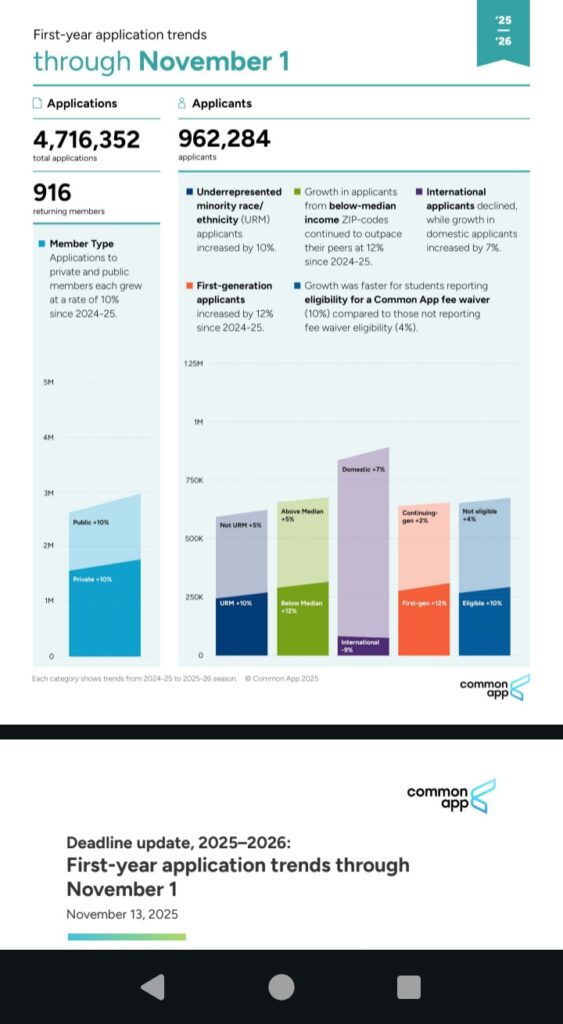
Eric from Solution Prep explained that there are different kinds of deadlines, and understanding them is crucial for your strategy.
Early Decision (ED):
- This is binding
- Can increase your chance of admission at many colleges
- You can only apply to ONE college Early Decision
- You, a parent, and your guidance counselor must sign that if accepted, you will withdraw applications from all other colleges
- You will attend this college if accepted
- Only select this if you’re absolutely positive you’ll go there if accepted
- This includes visiting the school’s website, checking the net price calculator, and confirming this college will be within your budget
Early Action (EA):
- This is non-binding
- You still get a leg up in the admissions process
- If they accept you, you can wait until May 1st to decide whether you’ll go there
Regular Decision (RD):
- Standard non-binding application
- Deadlines vary by school—some as early as December 1st, others in January
Rolling Admission:
- Schools consider applications as they’re received
- For schools with rolling admission, apply no later than their regular decision deadline
- After that, they’re only considering students on space-available basis
Setting Your Personal Writing Deadline
Eric provided strategic advice that made a lot of sense to me: “The writing deadline for you should be before the final deadline because you’re not the only person contributing to your college application.”
He explained that guidance counselors need time to submit transcripts and letters of recommendation. Also, sometimes after you apply to a college, they might ask for additional essays or invite you to apply for the honors college.
His recommendation: Set your writing deadline a month before your final deadline. This buffer ensures you always make your deadlines even if life gets busy.
The Writing Section: Your Personal Statement
Understanding the Essay Prompts
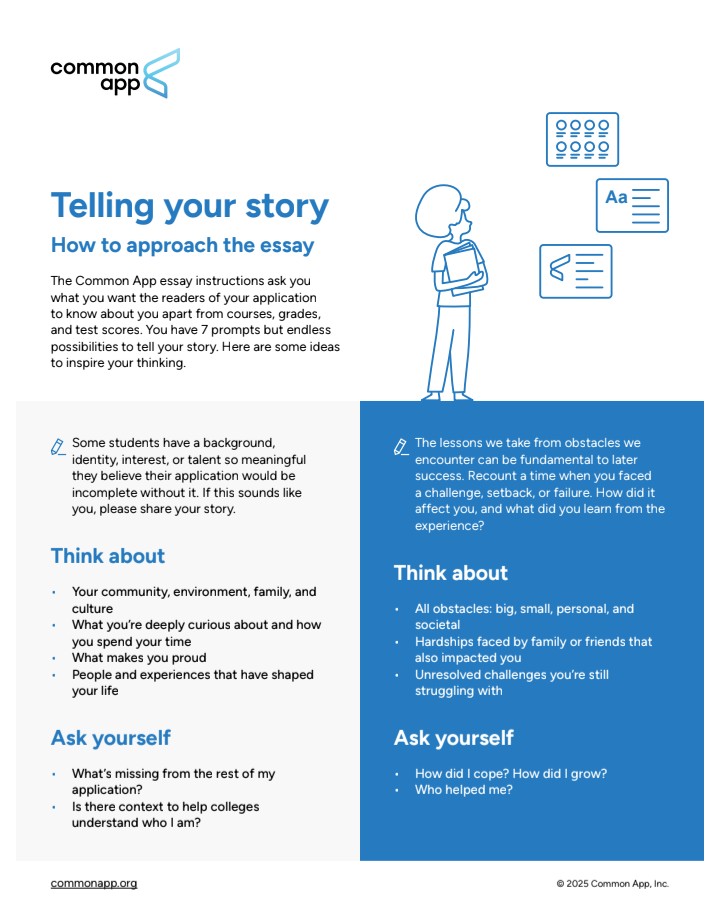
According to the College Essay Advisors tutorial, in the Writing section you’ll select which prompt you’ve responded to in your personal statement, then paste that essay.
Thomas noted that you get seven prompts in the Common App. He always suggests using prompt number seven, which essentially lets you write whatever you want to the admissions officer. You can use other prompts to generate ideas, but he likes the freedom of just being able to freewrite.
What Makes a Good Admissions Essay
Thomas provided extensive guidance that challenged common assumptions:
You do NOT need a trauma essay. He stated clearly: “You will read a lot of trauma essays or major life event essays on the internet. Stay away from those. For some students, that is the modality, that is their story. But for most students, it’s really not.”
Figure out how to distill the essence of who you are. Show the readers, don’t tell them. Use evidence, don’t just talk about activities. Talk about values and who you are, then use activities to illustrate how you live that, how you manifest that.
Don’t write about family members. Thomas emphasized: “Don’t talk about family. Family leads you down the rabbit hole.” While he understands people admire their parents, and you can drop a quick line about them, don’t over-rely on family stories. “We don’t need a story about your grandparents. We don’t need a story about your parents. You can get to the point and then talk about yourself.”
The Difference Between English Essays and Admissions Essays
Thomas made a crucial distinction that I found really valuable: “There is a huge difference between an English essay—one that you write for English class or one that your English teacher has edited—and an admissions essay.”
He explained that English teachers are interested in story, beauty, and narrative arc. What often happens with English-influenced essays is you get a long story, and at the end it’s like “and from that I learned responsibility and growth and how to listen to other people.”
He said no—we need to evidence those qualities throughout the essay instead of just jamming them in as an afterthought at the end.
No Gimmick Essays
Thomas was very clear about this: “No gimmick essays, no metaphors, no ‘my box of photographs and here’s five vignettes from my life.’ No poetry, no creativity.”
He clarified: unless you are applying as a poet and you’ve won awards as a poet, even then it’s not a good idea. The admissions essay has a specific purpose and format that works.
The Additional Information Section
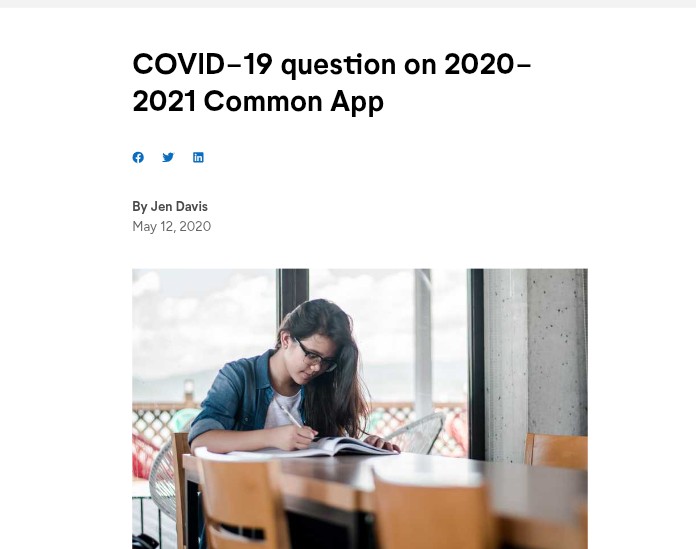
The College Essay Advisors tutorial noted that Common App provides an Additional Information section. This section gives students space to talk about something that may have impacted their academic history, such as COVID-19, natural disasters, family emergencies, etc.
Thomas provided important guidance about the two newer essay sections in Common App:
Hardship or Challenge Essay: One asks about a hardship or challenge you may have faced.
Additional Information: This has been reduced from 650 to 300 words.
His critical advice: “It’s very important that you only use those if you need to. Don’t feel like if you don’t have a hardship, you’re at a disadvantage. It’s perfectly fine to not have a hardship. Don’t put information in the additional information essay just to do it, just because you’re like ‘Oh, free space, might as well use that.'”
He explained that this gets to judgment, and judgment is something you are evaluated on. Using these sections unnecessarily can actually work against you.
Finding Supplemental Essays: The Hidden Challenge
Why This Is Crucial
Eric from Solution Prep emphasized something that really surprised me in my research: “The biggest mistake families make about the Common App is assuming that if their colleges are on the Common App, they only have to do the Common App portion and they’re done.”
He explained that his focus would be on two big parts: deadlines and essays (supplements). “Deadlines and essays, deadlines and essays. That’s our focus.”
Where Supplemental Essays Hide
Through Eric’s detailed tutorial, I learned that supplemental essays hide in multiple places, and you have to be thorough to find them all.
Some colleges have separate Writing Supplement sections:
- Carnegie Mellon has a separate “Writing Questions” section below their main application sections
- George Washington University also has writing in a separate place
- When schools have writing in a separate place, you need to submit the application twice—review and submit the Common App, then also review and submit the writing supplement
Some colleges hide essays in the Questions section:
- Harvard doesn’t have a separate writing supplement section
- You have to go into “Questions,” scroll down to “Short Answers,” and that’s where you’ll find essay requirements
Some colleges hide essays in Activities:
- High Point actually has essays within the Activities section
- You might see 50-word essays there that students overlook
Some colleges have “optional” essays:
- George Washington University has an optional essay marked with a green check
- Eric emphasized: “When a college has an optional essay, you want to see that word ‘optional’ as ‘opportunity’—as in you have the opportunity to stand out from among other students who didn’t put in the extra work”
The Common App is Dynamic
This was one of the most important things I learned from Eric’s tutorial: “The Common App is dynamic. Questions populate based on your answers to other questions.”
What this means: before you can know for sure that you’ve truly found all your essays, you need to answer basic questions like:
- Your starting term
- Your campus selection
- Your major
- Whether you’re applying for honors college
All these questions may populate new essays for you to write.
Penn State example: Eric showed that Penn State is notorious for this. When you select your degree type and major, new questions pop up. When you select a specific campus like University Park, suddenly the Schreyer’s Honors College option appears. Click on that and you might find 10 supplemental essays you didn’t know existed.
His advice: “So be so careful. Now, you may not know yet if you’re looking to apply to an honors college. For now, if you’re unsure, just say yes and copy and paste all the essays into your document. You can always decide later you’re not going to do it.”
Schools That Open Later
Eric also noted that some schools don’t open their supplements until later. Princeton, for example, historically doesn’t open until September 1st. He advised: “Don’t panic if some of these schools aren’t open yet. Just work on what you can work on, and don’t worry yet about what you can’t.”
Getting Organized: The Spreadsheet System
Why You Need a Tracking System
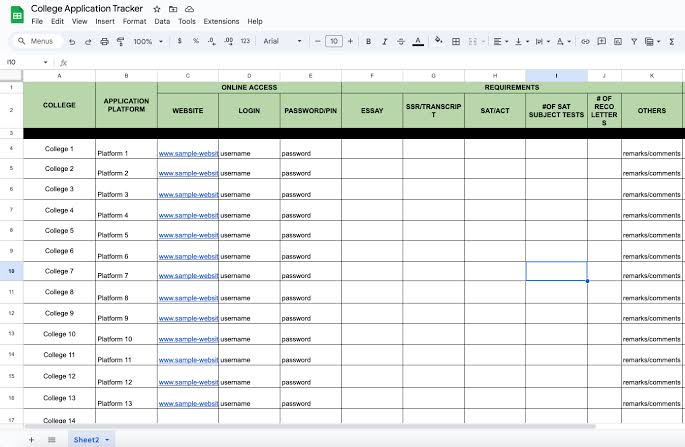
Eric provided a comprehensive organizational system that really makes sense. He created a folder system and spreadsheet to track everything, and he walked through exactly how to build this.
The College Application Spreadsheet includes columns for:
- College name
- Which application platform (Common App, Coalition, UC, etc.)
- Final deadline
- Writing deadline (one month before final deadline)
- Type of application (ED, EA, RD, Rolling)
- Supplement summary (how many long/short/micro essays)
- Number drafted
- Number finalized
- Whether a resume is needed
- Major
- Test score decision
- Safety/fit/reach designation
How to Fill Out Your Spreadsheet
Step 1: Add all your colleges
Go to Common App’s College Search, add all colleges you’re applying to or might apply to.
Step 2: Find deadlines
For each college:
- Go to “My Colleges”
- Click on the specific college
- Click “College Information”
- Find their deadlines section
- Copy the deadline for your application type
- Paste into spreadsheet
Step 3: Format dates properly
Click on the deadline column, go to Format > Numbers > Date. This converts everything to actual dates, allowing you to sort everything by when it’s due.
Step 4: Set writing deadlines
Make your writing deadline one month before the final deadline for every school.
Step 5: Find and categorize all essays
Eric created a system where:
- Essays 350+ words = “long”
- Essays under 350 words = “short”
- Essays under 150 words = “micro”
For each college, you note something like “3 short” meaning three short essays, then track “0 of 3 drafted” and “0 of 3 final.”
The “All the Prompts” Document
Eric demonstrated creating a master document called “All the Prompts” where you:
- Copy every essay prompt from every school
- Organize by school (use headings so you can jump between schools)
- Include word counts
- Link to individual school folders if you want to work on essays separately
This document becomes your master reference so you can see everything in one place and identify where prompts might overlap between schools.
Setting Up Counselor and Recommenders
Thomas emphasized: “Make sure that you set up your counselor and recommenders, that you have asked them, that they’re aware of why you’re applying, where you’re applying. Make sure they receive the invitations and you follow up on that.”
This is crucial because your application isn’t complete without these components, and other people need time to complete their parts.
Building Your School List Strategically
Thomas advised: “Go and build your supplement list. Take the schools you know you want to apply to, put them on your list. Then go into the early action/early decision schools and put the data in, click the major boxes.”
Why do this early? Because many times clicking on a specific major generates new essay prompts. He shared: “I can’t tell you how many times I get students panicking because it’s a day before the application is due or sometimes hours before, and they’re like ‘Oh my gosh, I just clicked on biology major and it threw up another 400-word essay. What do I do?'”
His point: you can’t do anything good in that compressed timeframe, and now you’ve just pushed an early school into regular decision and hurt your admission chances.
Doing Your School Research
Thomas emphasized the importance of researching schools thoroughly before writing your “Why Us” essays:
- Why are you majoring in that specific subject at that school?
- What’s unique about the major there?
- What’s unique about the school itself?
He explained: “There’s no right or wrong answer here. The right answer is why is it the right place for you?”
He warned against generic responses: “If you find yourself saying ‘well, there’s a diverse student body and these great professors,’ save that for the website, save that for the brochure. This is about your experience through the school.”
The entire application is about you. It needs to tell your story, draw the admissions officer in, and show them who you are unapologetically—your wins, your losses, things you did well, things you could do better at.
Common Mistakes to Avoid
Based on all the tutorials I researched, here are critical mistakes to avoid:
1. Assuming Common App is all you need Most schools require supplemental essays beyond the Common App.
2. Not using the preview button Always preview each section to see how it will appear to admissions officers.
3. Doing everything last minute The academic section alone is tedious and time-consuming. Start early.
4. Including middle school activities Unless there’s clear continuity into high school, leave out middle school accomplishments.
5. Writing vague activity descriptions Use your 150 characters efficiently—focus on leadership, awards, impact, not just stating your title.
6. Ignoring the dynamic nature of Common App Answer major, campus, and honors college questions early to reveal all hidden essays.
7. Treating optional essays as actually optional “Optional” means “opportunity to stand out”—take advantage of it.
8. Not setting a personal writing deadline Give yourself a month buffer before the actual deadline.
9. Over-relying on family stories in essays The essay is about you, not your parents or grandparents.
10. Using gimmicks, metaphors, or poetry in your personal statement Stick to straightforward, authentic storytelling.
11. Forgetting to submit both parts When schools have separate writing supplement sections, you must submit both the main app and the writing supplement.
12. Not tracking everything systematically Use a spreadsheet to manage deadlines, essays, and progress across all schools.
My Research Takeaways
After spending extensive time researching Common App through these expert tutorials, here’s what stood out to me most:
The process is more complex than it appears. You’re not just filling out one application—you’re managing multiple deadlines, finding hidden essays, tracking progress across potentially 10-20 schools, and ensuring every detail is perfect.
Strategy matters more than most students realize. Your activities should connect to your essays. Your essays should reflect your intended major. Everything should tell a coherent story about who you are and what you’re passionate about.
Organization is non-negotiable. Without a system—whether it’s a spreadsheet, folders, or some other method—you will miss essays, forget deadlines, or submit incomplete applications.
The essay is your voice, not your English teacher’s. While it’s fine to get feedback, the admissions essay serves a different purpose than what you write for English class. It’s about showing who you are through specific examples, not crafting beautiful prose for its own sake.
August 1st isn’t a day of fear—it’s a day of opportunity. Yes, there’s a lot of work ahead, but with the right approach and preparation, you can submit applications that truly represent who you are and put you in the best position to reach your goals.
Final Advice from the Experts
Thomas’s closing advice really resonated with me: “Take your time, breathe. There’s a lot here, but I’ve got you. We’re going to do this together. We’re going to get you to your dream school. And you know what? We’re going to have fun doing it.”
Eric reminded students to reach out for help when needed and to stay organized throughout the process.
The College Essay Advisors noted that the 2024-25 Common App didn’t change drastically compared to previous years, so students who’ve familiarized themselves with the system won’t face big surprises.
For students applying in 2026, the foundation remains the same: careful preparation, attention to detail, strategic thinking, and authentic self-presentation. The Common App opens doors to over 1,000 colleges—make sure your application showcases the best version of yourself.
Want to share your college application journey? Join Inkwrit and connect with students and professionals navigating education decisions together.

Author: Bridget Austin
Ifeoma, who writes under the pen name Bridget Austin, is the founder of Inkwrit — a freelance writing platform built for African writers and storytellers. With a background in copywriting and content strategy, she created Inkwrit to give African voices a professional home to publish, build portfolios, and grow their writing careers. When she's not building the Inkwrit community, she writes about freelance writing, African literature, and the business of creative work.