
“Mara feels guilty” tells a reader how to interpret a character. It does not yet tell a camera what to show. Before turning that sentence into a Kling 4.0 scene concept, give Mara a situation in which she can make an observable choice.
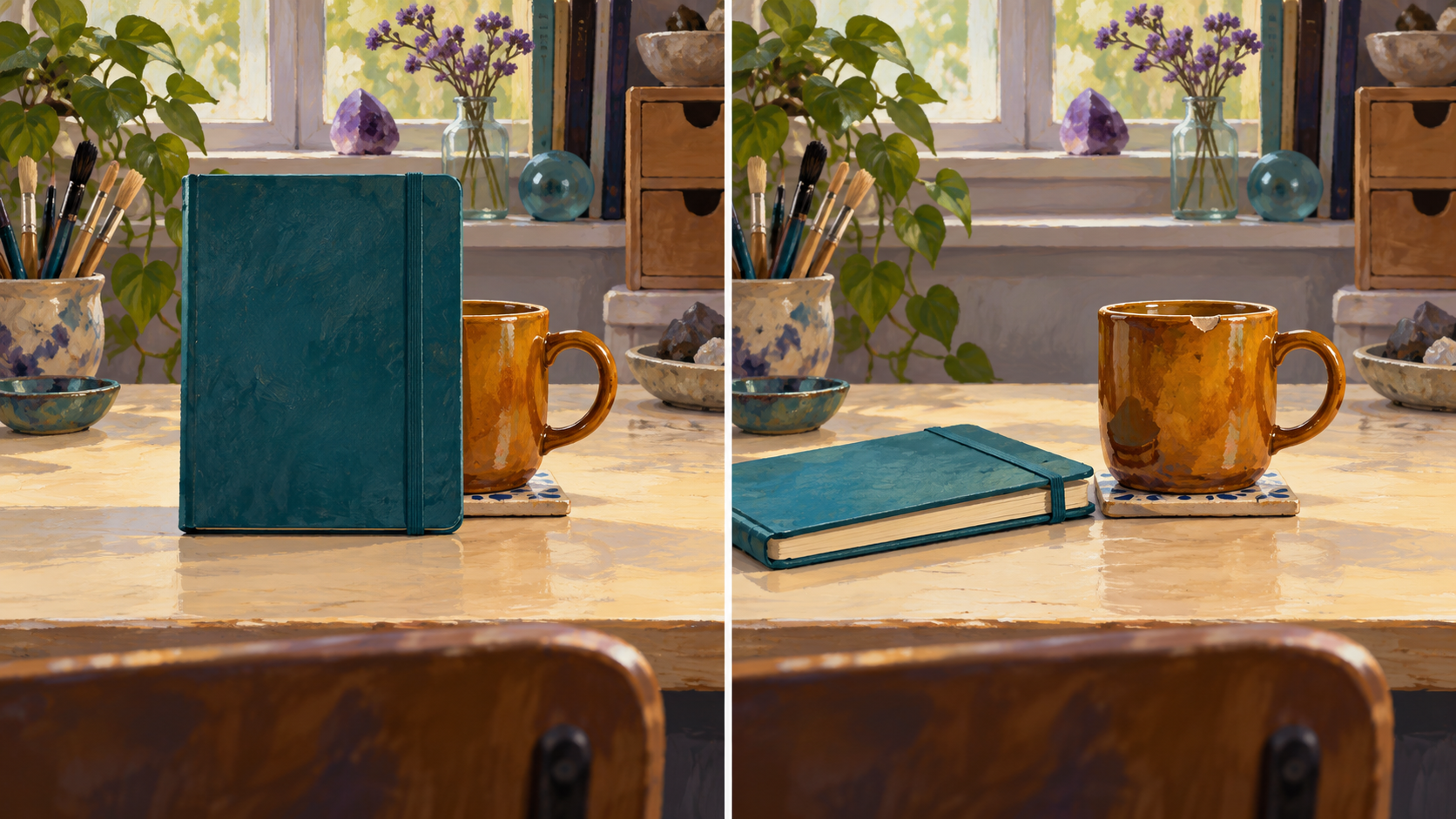
Our exercise is small: a chipped amber mug stands beside a teal notebook on a workshop desk. Mara can stand the closed notebook upright in front of the mug, or lay it flat and move it to one side, leaving the chip visible. Neither action proves guilt on its own. Each gives the surrounding story something concrete to work with.
Mara, the workshop and the AI-assisted illustrations in this guide are invented. They are writing examples, not a filmed performance or a model-generation result.

Give the character something they can choose to do
An emotional adjective often hides a missing decision. “Nervous,” “brave” and “ashamed” can describe a mood without creating an action that matters to the scene.
Start by naming the immediate situation. The chipped mug is visible on a desk that another person will soon use. When stood upright in front of the mug, the notebook can cover the damaged area from that person’s likely view. Mara notices both.
Now ask what changes if she acts. If she stands the notebook upright in front of the mug, the chip is harder to see. If she lays the notebook flat and moves it to one side, she leaves the chip exposed. The audience can observe that difference even without a line of dialogue.
Keep the choice small enough to understand. A character who simultaneously hides the mug, writes a confession, answers a phone and leaves the room creates several competing signals. Choose the action that this scene needs.
Write two alternatives before polishing either
Try these short versions:
Version A
Mara looks at the chipped rim. She stands the closed notebook upright between the mug and the empty seat across the desk, blocking the damaged rim from that view. Her hand leaves the notebook standing there.
Version B
Mara looks toward the mug behind the upright notebook. She lays the closed notebook flat and moves it to one side of the mug. The damaged rim becomes visible from the empty seat across the desk.
The mug and room do not have to change. The alternatives differ in the character’s decision about visibility. This makes the writing easier to compare than two paragraphs filled with different lighting, props and emotional labels.
Neither version settles the motive. Mara might be concealing damage, protecting someone else’s feelings, arranging a workspace or preparing to explain what happened. Establish the relevant context elsewhere in the story. An isolated movement should not be asked to communicate an entire backstory.
Make the viewpoint part of the sentence
“She hides the mug” is incomplete if the image shows it clearly to everyone who matters. State whose view is obstructed and what the audience should still understand.
For Version A, a viewpoint near the empty seat can show the upright notebook blocking the chip. A different view might let the audience see the concealment while making clear that the arriving person would not. Those are different dramatic arrangements.
For Version B, choose a view that lets the reader see the damaged rim after the notebook is laid flat and moved to one side. If the handle or the mug’s far side hides the chip throughout, the physical action has lost the information the scene was written to reveal.
You can sketch the desk first. Mark the mug, notebook, empty seat and viewing direction. The sketch does not need to be beautiful. Its job is to expose a contradiction before you spend effort on descriptive prose or a visual prototype.
Translate the choice into a restrained scene brief
Once you prefer an alternative, write its visible events rather than listing emotions. A brief for Version B could be:
At a plain workshop desk, a closed teal notebook stands upright in front of an amber mug, blocking its small chipped rim from the opposite seat. A person in a violet sweater pauses, then lays the notebook flat and moves it to one side of the mug before withdrawing their hand. The mug stays still. From the opposite seat, the chipped rim is now visible. Hold the view on the uncovered mug.
This is a creative instruction to explore, not a promise that a tool will preserve the chip or render a precise hand movement. The useful review questions are already present: was the upright notebook laid flat and moved to one side, did the mug remain, and can the viewer see the detail that motivated the choice?

If a candidate adds a dramatic crack, repairs the mug or makes it vanish, the scene has changed. Decide whether you want that new event. Do not retain it merely because it looks striking while continuing to describe the original choice.
Keep interpretation with the writer
A quiet physical action can carry meaning, but the writer still controls its context. Read the scene once with all emotional adjectives removed. Then explain what the audience can observe and what they must learn from the earlier or later writing.
For a visual concept attempt after that exercise, you can inspect the Flyne AI Kling 4.0 preview. On 28 October 2026, the page was labelled Preview and its embedded form showed Kling 3.0 Turbo. Check the model actually selected and the available inputs before trying the brief; the page title is not evidence that an output came from Kling 4.0.
Disclosure: This article is provided by the Flyne AI brand team.
As a second exercise, keep the desk and objects but change what Mara wants another person to notice. Write the new decision in three sentences. If the action is understandable without explaining a feeling in every sentence, you have given the scene something concrete to show—and left room for the story to explain why it matters.